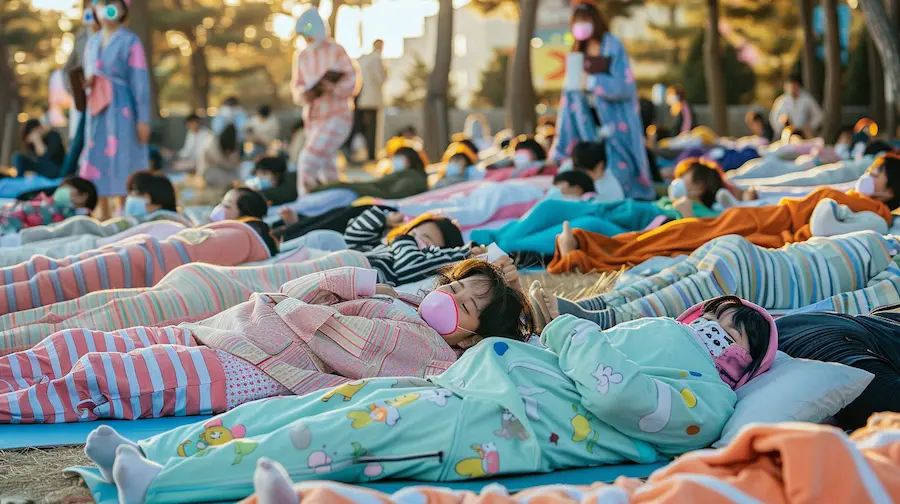
Picture this: It is a sunny Saturday afternoon in May 2026. You are strolling along the banks of the Han River in Seoul, expecting to see people cycling, eating fried chicken, or flying kites. Instead, you stumble upon a bizarre sight. Nearly 200 people are lying on yoga mats, dressed in everything from pyjamas to giant koala costumes, fast asleep. Judges are walking around with clipboards, occasionally tickling the sleepers with feathers or playing mosquito sounds near their ears.
This is not a flash mob or a strange performance art piece. It is the 3rd annual Hangang Nap Competition, organised by the Seoul Metropolitan Government itself.
In a country historically famous for its relentless work ethic, pali-pali (빨리빨리, meaning “hurry, hurry”) culture, and neon-lit office buildings that stay illuminated long past midnight, a competition that rewards people for doing absolutely nothing feels almost rebellious. Yet, this quirky event perfectly encapsulates a profound cultural revolution currently sweeping across South Korea: the desperate, collective yearning for genuine work-life balance.
The Legacy of the “Overworked Nation”
To understand why a nap competition is making international headlines on CNN and the Associated Press, you first need to understand the sheer exhaustion of the South Korean workforce.
For decades, South Korea’s miraculous economic rise — the so-called “Miracle on the Han River” — was built on the backs of its incredibly hardworking citizens. However, this came at a severe cost. As recently as 2022, South Korea ranked as the fifth most overworked country in the OECD, with employees clocking an average of 1,901 hours per year. To put that into perspective, that is 149 hours more than the OECD average, and hundreds of hours more than workers in the United Kingdom or Germany.
The physical and mental toll has been staggering. A 2022 survey by the Ministry of Employment and Labour revealed that nearly 40% of full-time employees reported symptoms consistent with workplace burnout. A 2025 government report further highlighted that three in ten young adults had experienced severe burnout in the previous year. South Koreans are also chronically sleep-deprived, sleeping an average of 1 hour and 35 minutes less than the recommended 7 to 9 hours for adults — and seven in ten Koreans admit to using their smartphones right up until the moment they fall asleep.
The breaking point arrived in early 2023 when the government proposed extending the maximum legal workweek to a staggering 69 hours. The backlash from the younger generation was swift and fierce, forcing the government to abandon the plan entirely. It was a watershed moment: the youth had collectively decided that enough was enough.
The Art of Doing Nothing: A Cultural Rebellion
The recent Hangang Nap Competition is actually a spin-off of an older, equally fascinating event: the Space-Out Competition (멍때리기 대회).
Founded in 2014 by a visual artist known as Woopsyang (Hwang Ji-hae), the Space-Out Competition was born directly out of her own severe burnout. The rules are brilliantly simple yet incredibly difficult for modern, smartphone-addicted humans: sit completely still for 90 minutes without talking, sleeping, checking your phone, or doing anything at all. The winner is the person who maintains the lowest and steadiest heart rate, measured every 15 minutes.
“In a country known for its long working hours and intense academic pressure, doing nothing is often viewed as a waste of time. I wanted to turn doing nothing into a valuable, competitive sport.” — Woopsyang, Founder of the Space-Out Competition.
What started as a small, eccentric art project has blossomed into a highly anticipated annual event covered by The New York Times, The Guardian, and CNN. The 2026 Nap Competition took this concept a step further. Out of numerous applicants, 170 participants were selected based on their personal stories of exhaustion. Among them was a nurse in her 20s who simply wanted a break after gruelling shifts, and an engaged couple in their 30s overwhelmed by wedding preparations and relentless overtime.
These events are no longer just quirky festivals. They are public declarations that rest is not a luxury, but a fundamental human right.
The MZ Generation and the “Quiet Quitting” Era
The driving force behind this revolution is South Korea’s “MZ Generation” — a local term combining Millennials and Generation Z. Unlike their parents, who prized lifetime employment and unwavering loyalty to a single company, the MZ generation prioritises individual growth, mental health, and transparent rewards.
This shift has manifested in several visible ways. The global trend of “quiet quitting” — doing exactly what your job description requires and nothing more — has taken firm root in Seoul’s corporate culture. Young professionals are increasingly refusing to participate in hoesik (회식, mandatory after-work drinking sessions with superiors) and are leaving the office exactly when the clock strikes 6:00 PM, regardless of whether their boss is still at their desk.
More concerning for the broader economy is the rise of the “Resting Youth” (쉬었음 청년). By late 2025, hundreds of thousands of young people had opted out of the job market entirely — not because they could not find work, but because they were too burnt out to participate in the traditional corporate grind. The Bank of Korea reported that approximately 211,000 youth jobs were lost between mid-2022 and mid-2025, with many young people choosing rest over relentless hustle.
From Grassroots to Government Policy
The government and major corporations have finally recognised that the old ways are no longer sustainable. If South Korea wants to address its demographic crisis — including having one of the world’s lowest birth rates — it must fundamentally fix its work culture.
As of 2026, sweeping legislative changes are underway. The government has introduced the Working Hours Reduction Support Act, which aims to bring South Korea’s real working hours down from 1,859 hours in 2024 to approximately 1,739 hours by 2030, closer to the global OECD average.
Perhaps the most revolutionary change is the proposed “Right to Disconnect” law. This legislation aims to legally protect workers from having to reply to work-related messages or emails after their official shift ends. For anyone familiar with Korean corporate culture — where a late-night KakaoTalk message from a senior manager was once considered perfectly normal — this represents a seismic cultural shift.
Furthermore, the four-day (or 4.5-day) workweek is no longer a distant pipe dream. Major conglomerates including Samsung Electronics, SK Hynix, Kakao, and POSCO have already adopted flexible working arrangements or shortened weeks. In 2025, Gyeonggi Province — South Korea’s most populous region — launched a significant trial of the four-day workweek across 50 public and private organisations. A survey by the job portal Saramin found that 83.6% of South Koreans support the four-day workweek.
| Policy / Initiative | Status (2026) | Key Detail |
| Working Hours Reduction Support Act | Submitted to National Assembly | Target: 1,739 hrs/year by 2030 |
| Right to Disconnect Law | Proposed (2026) | Protects workers from after-hours messages |
| 4.5-Day Workweek (National) | Pilot ongoing | President Lee’s flagship policy |
| Gyeonggi Province 4-Day Trial | Completed (2025) | 50 organisations participated |
| Corporate Adoption (4-day/4.5-day) | Active | Samsung, SK Hynix, Kakao, POSCO, CJ ENM |
A Lesson for the World
South Korea is currently in a fascinating transitional phase — a country caught between its deeply ingrained Confucian work ethic and a modern, urgent need for rest and balance.
The sight of hundreds of people competitively napping on the banks of the Han River is undeniably humorous. But it is also a poignant reminder of a universal human truth: you cannot pour from an empty cup. As South Korea navigates this transition, it offers a compelling lesson for workplaces everywhere. Economic miracles are impressive, but they are ultimately meaningless if the people building them are too exhausted to enjoy the results.
So the next time you feel guilty for taking a 20-minute power nap or ignoring a work email on a Sunday evening, just remember the competitors in Seoul. Sometimes, doing absolutely nothing is the most productive thing you can do.
Have you ever experienced Korea’s intense work culture firsthand? Or do you think your country could use a nap competition of its own? Share your thoughts in the comments below.
References
1.Korea Herald, “Han River nap contest returns”, May 2026.
2.OECD, “Hours Worked”, 2022 data.
3.Deskimo, “Burnout Epidemic in South Korean Workplaces”, Nov 2025.
4.KBS World, “3 in 10 Young S. Korean Adults Have Suffered Burnout”, Dec 2025.
5.Chosun English, “7 in 10 Koreans Use Smartphones Until Bedtime”, Mar 2026.
6.The New York Times, “Trying to Win at Doing Nothing, With a Crowd Watching”, Jul 2025.
7.The Korea Times, “Dreaming of victory: Seoulites to face off in napping contest”, Apr 2026.
8.The Diplomat, “The ‘Resting’ Generation and South Korea’s Youth Recession”, Feb 2026.
9.Diplomatic Courier, “South Korea to reduce real working hours”, Jan 2026.
10.Korea JoongAng Daily, “Ignore late messages from the boss?”, Mar 2026.
11.4 Day Week Global, “4 Day Work Week in South Korea”, 2026.
12.Semafor, “South Korea Trials 4-Day Work Week”, Aug 2024.