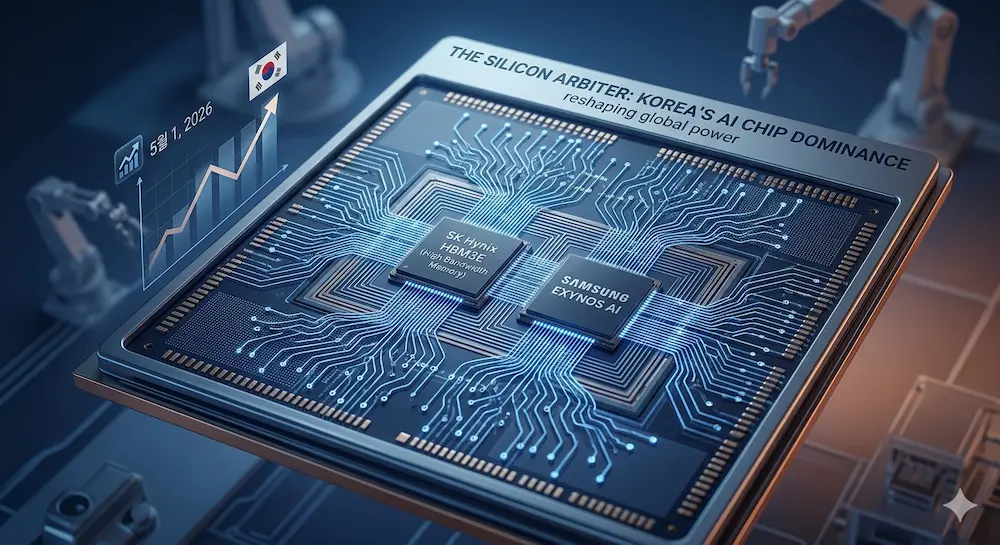
From Memory Chips to AI Leadership—Why Korea Holds the Key to the Future
If you’ve been paying attention to tech headlines lately, you’ve probably noticed something remarkable happening in South Korea. On April 27, 2026, SK Hynix’s stock price hit an all-time high, soaring 7% in a single day. That might sound like just another market movement, but it signals something far more significant: Korea is quietly becoming the world’s most critical player in the AI revolution.
This isn’t a story about smartphones or consumer gadgets. This is about the chips that power artificial intelligence itself. And Korea’s dominance in this space is reshaping global power dynamics in ways most people don’t yet understand.
The Invisible Engine: Why AI Chips Matter
When you use ChatGPT, when you ask Siri a question, when you watch Netflix’s recommendation algorithm suggest your next show—you’re relying on AI chips. But not all AI chips are created equal. There’s a hierarchy, and at the very top sits a specific type of chip called HBM: High Bandwidth Memory.
Think of HBM like the nervous system of an AI computer. It’s not the brain (that’s the GPU or processor), but it’s what allows the brain to think fast. Without HBM, even the most powerful AI processor would be like a genius trapped in slow motion.
For years, this market was fragmented. But in 2026, something shifted. SK Hynix, a South Korean company most people outside the tech industry have never heard of, emerged as the clear leader in HBM production. And that matters—a lot.
The Numbers Tell the Story
In April 2026, SK Hynix reported a five-fold increase in quarterly profit. That’s not a 5% increase. That’s a 500% jump. The company’s earnings surged because of one thing: soaring demand for AI memory chips, combined with limited supply.
Here’s the context: as AI companies like OpenAI, Google, and Meta race to build larger and more powerful AI systems, they need massive quantities of HBM. But there aren’t many companies that can make it. SK Hynix can. Samsung, Korea’s other chip giant, is trying to catch up but is facing labour challenges. Intel and other Western chipmakers are years behind.
The result? SK Hynix can charge premium prices. The company’s revenue did miss some forecasts, but the profit margins tell the real story: the company is making money hand over fist on every chip it sells.
Why This Matters Beyond Korea
You might be thinking: “That’s great for SK Hynix shareholders, but why should I care?” The answer is that this isn’t just about one company’s profits. It’s about geopolitical power.
Right now, the United States is the undisputed leader in AI software and algorithms. Companies like OpenAI, Google, and Meta are setting the pace for AI development. But they all depend on one thing: the chips that run their systems. And increasingly, those chips come from Korea.
This creates a fascinating dynamic. The U.S. leads in AI innovation, but Korea controls a critical chokepoint in the supply chain. It’s like being the world’s best chef but depending on one farmer for your ingredients. That farmer suddenly has a lot of leverage.
China, meanwhile, is watching this closely. The country has been trying to develop its own advanced chip capabilities, but it’s facing international restrictions and technical challenges. For now, China’s AI ambitions depend partly on access to Korean chips—a dependency that gives Korea unexpected geopolitical influence.
The Global Semiconductor Boom
To understand how significant Korea’s position is, you need to see the bigger picture. In 2026, the global semiconductor industry is on track to reach $1.3 trillion in annual revenue—a historic milestone. This isn’t just about AI; it’s about the entire digital economy.
Korea is riding this wave. South Korea’s exports are at record levels, driven substantially by semiconductor sales. The country’s two chip giants—SK Hynix and Samsung—are both benefiting, though SK Hynix has pulled ahead in the AI-specific market.
But here’s the catch: this boom might not last forever. Samsung is investing heavily to catch up. The U.S. is pushing hard to build domestic chip capacity (partly through the CHIPS Act). And other countries are investing billions to reduce their dependence on Korean and Taiwanese chips.
The Counterargument: Is Korea’s Dominance Fragile?
Now, if you’ve been following tech industry trends, you might be thinking: “Wait, doesn’t Taiwan dominate chip manufacturing? What about TSMC?” And you’d be right to ask.
Taiwan’s TSMC is the world’s leading chip manufacturer by volume and sophistication. But TSMC specializes in logic chips—the processors that do the computing. Korea specializes in memory chips—the storage that holds data. These are different markets, and right now, memory is where the money is in AI.
It’s also worth noting that Korea’s dominance in HBM is recent and could be challenged. Samsung is investing $73 billion to reclaim AI chip leadership. Western companies are pouring resources into catching up. And geopolitical tensions could disrupt supply chains in unpredictable ways.
Some analysts argue that Korea’s current advantage is temporary—a window of opportunity that will close as competitors catch up. Others believe Korea has structural advantages (skilled workforce, existing infrastructure, government support) that will keep it competitive for years.
The truth is probably somewhere in between. Korea’s position is strong but not unassailable.
What This Means for the Future
So what happens next? Several things are already in motion.
First, Korea is doubling down on its advantage. SK Hynix announced plans to invest $13 billion in a new manufacturing plant in South Korea, with construction beginning in April 2026. The Korean government is launching a $687.8 million project to develop next-generation AI semiconductors. The message is clear: Korea intends to stay ahead.
Second, the global AI race is becoming a chip race. Companies that want to lead in AI need access to advanced chips. Countries that control chip supply have leverage. This is reshaping international relations in subtle but important ways.
Third, this is creating new opportunities and risks for Korea. The opportunity is obvious: enormous profits and geopolitical influence. The risk is that success breeds competition. If Korea becomes too dominant, other countries will invest heavily to break that dominance. It’s happened before in other industries.
The Bigger Picture: Technology and Power
What’s happening with Korean AI chips is part of a larger story about how technology shapes global power. For decades, the U.S. dominated because it led in innovation. But innovation alone isn’t enough. You also need to control the supply chains that make innovation possible.
Korea’s position in AI chips is a reminder that power in the 21st century isn’t just about ideas—it’s about the infrastructure that brings ideas to life. It’s about the factories, the supply chains, the skilled workers, the government policies that enable production.
This is why SK Hynix’s stock hitting an all-time high on April 27, 2026, matters. It’s not just about one company’s success. It’s a signal that the world is recognizing Korea’s critical role in the future of technology.
For people interested in understanding global power dynamics, geopolitics, and the future of technology, Korea’s AI chip dominance is a story worth watching closely.