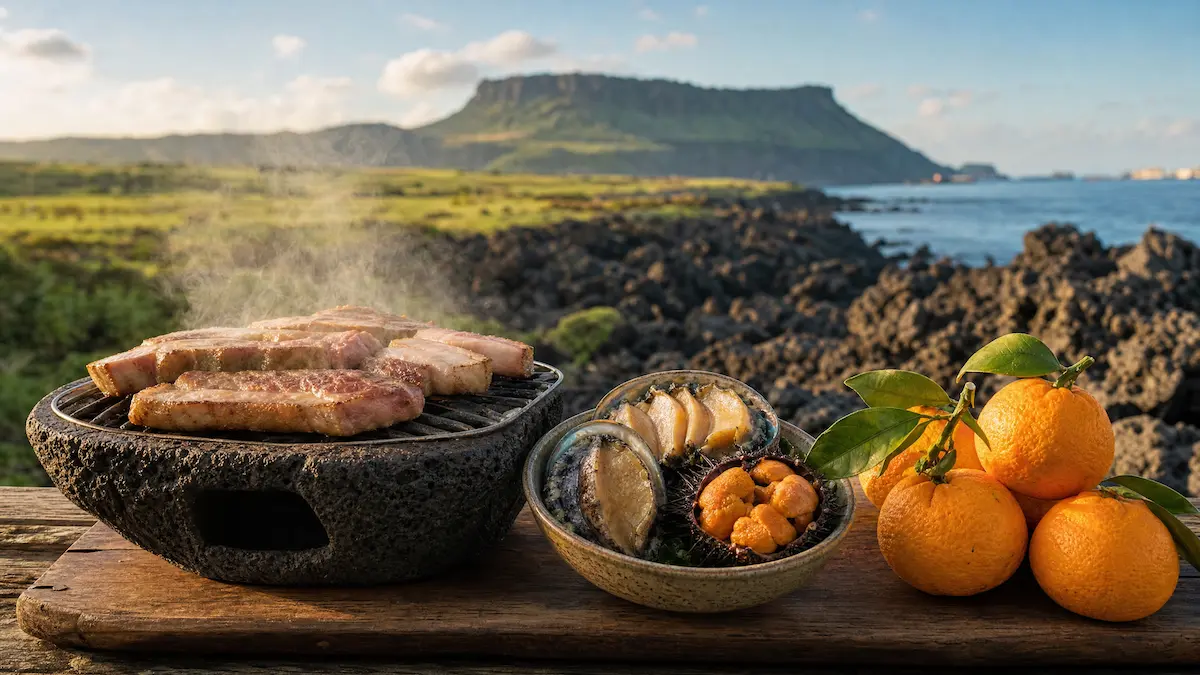
Jeju is often remembered through food.
Visitors think of tangerine orchards, black pork barbecue, seafood markets, coastal restaurants, abalone porridge, seaweed soup, haenyeo divers and small village cafés. For many travellers, eating on the island is not a side activity. It is part of the reason they go there.
But Jeju’s food story is no longer only about tourism.
The island is also trying to connect its local ingredients, farming traditions and marine resources with wider food production, regional branding, processed products and everyday consumer goods.
This should not be exaggerated.
Jeju is not suddenly becoming the centre of global food innovation. Seoul, Busan and larger industrial regions still have stronger research networks, company clusters and production systems.
The more accurate point is quieter, but more important.
Jeju is trying to make its food story less dependent on short-term tourism and more connected to local products, food quality, regional identity and practical distribution.
A Food Culture Shaped by the Island
Jeju’s food identity is different from that of mainland Korea.
The island’s volcanic landscape, mild climate, fishing culture and distance from the mainland have shaped what people grow, catch and eat. Tangerines, black pork, seafood, abalone, seaweed, barley-based foods and local vegetables are all closely tied to Jeju’s image.
For visitors, these foods often feel memorable because they belong to the place.
A bowl of seafood stew near the coast is not only a meal. Grilled black pork in Jeju City is not only barbecue. A box of tangerine snacks from a farm shop is not only a souvenir.
These foods carry the feeling of the island.
That local identity is now becoming more useful beyond restaurants and travel memories. As Korean food receives more attention outside Korea, regional food stories are becoming easier to explain to international consumers. Jeju has a clear image: island, nature, farming, seafood and local tradition.
That image is an advantage, but only if it is handled carefully.
A strong food brand cannot survive on scenery alone. It needs quality control, processing, packaging, logistics, safety standards and trust.
Public Support Is Changing the Direction
Jeju’s food industry is not growing only through restaurants and markets.
The provincial government has introduced support plans related to food technology, agriculture and local food production. These plans are connected to food-related facilities, local resources and higher-value products made from Jeju ingredients.
This matters because the goal is not simply to sell more raw ingredients.
The larger aim is to make Jeju’s agricultural and marine resources more useful beyond the island. That can include processed foods, smart farming, research facilities, product development and support for small local producers.
Jeju has also introduced support plans related to agriculture, livestock and food. These plans are connected to farm income, local food production, tangerine quality, eco-friendly livestock practices and animal disease prevention.
For readers outside Korea, the key point is simple.
Jeju is not treating food only as culture. It is also treating food as part of local planning and regional development.
The Pressure Behind the Shift
This change is not happening in a comfortable environment.
Food systems are under pressure from several directions. Farmers face labour shortages, rising costs, climate uncertainty and unstable distribution conditions. Livestock farms must also deal with disease risks such as avian influenza, African swine fever and foot-and-mouth disease.
These problems are not unique to Jeju. They affect Korea’s wider food system.
But they show why Jeju needs a broader food strategy.
A region that depends too heavily on one product, one season or one type of visitor demand becomes vulnerable. A stronger food system needs better prevention measures, more reliable logistics, more processed products, wider sales channels and brands that can travel beyond the island.
Food technology alone cannot solve every problem.
Still, it can help Jeju think beyond the simple model of growing food, serving tourists and hoping demand remains steady.
Black Pork Is Famous, But It Is Not the Whole Story
Jeju black pork is one of the island’s best-known foods.
Many travellers arrive with black pork already on their itinerary. Restaurants in Jeju City, Seogwipo and tourist districts often advertise black pork barbecue as a representative local meal.
Its appeal is easy to understand. The food is closely tied to Jeju’s regional image, and eating it on the island feels different from ordering ordinary pork barbecue elsewhere.
But Jeju’s food industry should not be reduced to black pork.
Black pork is a powerful tourism product. It is familiar, easy to explain and strongly connected to place. But Jeju’s wider food story also includes seafood, tangerines, processed foods, local beverages, agricultural products, snacks, sauces and consumer goods based on regional ingredients.
For visitors, black pork may be the first doorway into Jeju food.
For the island, it is only one part of a much larger system.
Seafood and the Haenyeo Tradition
Seafood is another major part of Jeju’s food identity.
The island’s coastal life is connected to fish, abalone, sea urchin, seaweed and shellfish. Jeju’s haenyeo, the female divers who gather seafood by hand without breathing equipment, are among the island’s most recognisable cultural figures.
Their work is not only economic. It is cultural heritage.
The haenyeo tradition has been recognised internationally, but it also faces real challenges. Many divers are elderly, younger workers are harder to attract, and marine environments are changing. If haenyeo culture is treated only as a tourist image, the deeper reality of their labour and community can be missed.
For Jeju’s food industry, seafood has both opportunity and responsibility.
Seafood can support restaurants, local markets and processed products. Jeju can also connect with Korea’s wider seafood policy direction if it strengthens cold-chain logistics, quality control and reliable distribution.
But marine resources must be managed carefully.
A serious food strategy cannot separate seafood from sustainability.
Tangerines and the Value of Processing
Jeju tangerines are one of the island’s clearest food symbols.
For many Koreans, Jeju and tangerines are almost inseparable. The fruit is sold fresh, but it also appears in juices, teas, desserts, jams, snacks, sauces and gift products.
This matters because processed products travel more easily than fresh fruit.
A tourist may eat tangerines in Jeju once. A bottled drink, packaged snack or fruit-based product can move to Seoul, Tokyo, Singapore or an online store.
That is why value-added products matter.
The next stage of Jeju food is not only about producing more ingredients. It is also about finding ways to store, package, brand and sell those ingredients in forms that can reach people who never visit the island.
This is where food technology, design and product planning become part of the same conversation.
Small Steps Outside Korea Matter
Jeju’s international food activity is still developing.
In 2026, several Jeju food and beauty companies were selected to participate in a premium consumer goods trade event in Tokyo. This does not mean Jeju has already become a major global food region. It simply shows the direction the island wants to test.
Japan is a valuable but demanding place for consumer products. Shoppers often pay attention to quality, packaging, origin, detail and trust. If Jeju companies can learn from that environment, they may become better prepared for other buyers as well.
This kind of activity should be described carefully.
A trade event is not a breakthrough by itself. It is a step. It gives small companies a chance to meet buyers, test product appeal, understand packaging expectations and learn how Jeju’s clean island image is received outside Korea.
That is enough to make it worth watching.
It does not need to be exaggerated.
What This Means for Travellers
For travellers, Jeju’s food story makes the island more interesting.
A visit to Jeju is no longer only about finding one famous restaurant. It can include black pork, seafood, tangerine products, traditional markets, farm cafés, coastal meals, local snacks and small brands experimenting with new products.
The best way to understand Jeju food is to connect the meal with the place.
Black pork tells a story about local livestock and tourism. Seafood tells a story about coastal work and haenyeo culture. Tangerines tell a story about farming, climate and regional branding. Processed food products show how the island is trying to reach people beyond visitors who physically arrive in Jeju.
This gives Jeju food more depth.
A meal becomes more than a checklist item. It becomes one way to understand how the island lives, works and adapts.
The Limits of the Trend
Jeju’s food transformation should not be overstated.
Public support can help local producers, but food distribution still depends on safety rules, packaging, logistics, pricing, branding and buyer trust.
Small companies may struggle even when their products are good. Farmers may still face unstable income. Fishing communities may continue to age. Climate pressure may affect crops and marine resources. Tourism demand may rise and fall depending on air routes, exchange rates and travel trends.
Jeju also has a geographic challenge.
Being an island gives Jeju a strong identity, but it can also make logistics more complicated. Moving food products from island farms and coastal communities to wider markets requires careful planning, reliable transport and steady coordination.
So Jeju’s food industry should not be described as a sudden boom.
It is better understood as a careful attempt to build a more durable regional food system around local identity.
A Regional Story Worth Watching
Jeju’s food industry matters because it shows how regional food systems are changing.
Around the world, many places are trying to protect local food culture while turning it into better products, travel experiences and wider consumer recognition. Jeju is part of that wider pattern.
The island has clear strengths: a strong regional image, famous ingredients, tourism demand, cultural heritage, agricultural resources and public support.
It also has real difficulties: labour shortages, disease risk, climate pressure, ageing producers, logistics costs and competition outside the island.
That balance is what makes the story important.
Jeju food is not only about what tourists eat on holiday. It is about how an island uses local identity, farming, seafood and small producers to build a more stable food story.
For travellers, that means Jeju offers meals with a deeper background.
For readers interested in Korea, it shows another side of the country: not only Seoul, K-pop and technology, but also regional farming, seafood, small producers and the difficult work of building a more resilient local food system.
Sources and Further Reading
Jeju Special Self-Governing Province food-tech industry plan, 2026
Jeju Special Self-Governing Province agriculture, livestock and food support plan, 2026
Ministry of Oceans and Fisheries, 2030 fisheries and fishing village development plan
UNESCO, Culture of Jeju Haenyeo
Korea Tourism Organization and Jeju Tourism Organization food and travel resources
Korea International Trade Association Jeju Branch consumer goods event notices
Google Search Central, Helpful, reliable, people-first content guidance