From Instant Noodles to Artificial Intelligence—Why Korea’s Convenience Stores Are Reshaping Retail Globally
When you first arrive in South Korea, one of the most striking observations is the sheer ubiquity of convenience stores. They cluster on street corners, nestle beside train stations, and populate residential neighbourhoods with remarkable density. GS25, CU, 7-Eleven, Emart24—the names become familiar within days. Most foreign visitors regard them as curiosities of Korean life: places to grab a quick snack, perhaps to marvel at the peculiar product combinations on display. Few pause to consider that these humble retail spaces are undergoing a profound transformation that may well reshape the global retail landscape.
Yet here lies a compelling narrative, one that reveals something fundamental about how Korean businesses respond to market saturation and changing consumer expectations. The convenience store innovation Korea represents not merely a commercial strategy, but a fundamental recalibration of retail purpose itself. This transformation in convenience store innovation Korea marks a watershed moment in how retailers approach market saturation and consumer expectations.
The End of Scale: Convenience Store Innovation Korea Begins
The statistics tell a story of transition. Between 2024 and 2025, South Korea’s convenience store count declined for the first time in the sector’s modern history—from 54,852 outlets to 53,266. This is not merely a numerical fluctuation. It represents a fundamental recalibration of retail strategy.
For three decades, Korean convenience store chains pursued a singular doctrine: expansion through proliferation. More stores in more locations equalled more customers, which equalled greater revenues. The mathematics appeared immutable. Yet by 2025, this formula had begun to falter. Year-on-year sales growth, which had reached 8 per cent in 2023, had compressed to a mere 0.1 per cent by 2025—a figure that approaches statistical insignificance.
Industry executives acknowledged the shift with candour. As one senior retail strategist remarked, “The era of competing solely on store count has concluded. The next phase will be defined by the purpose embedded within each space.” This observation underscores the strategic pivot: convenience store innovation Korea is no longer about proliferation, but about differentiation and experiential excellence.
This acknowledgement marked a watershed moment. Convenience stores would no longer compete through proliferation, but through differentiation and experiential innovation—a principle that now defines convenience store innovation Korea across all major chains.
The Laboratory Emerges: Innovation in Korean Retail
To observe this transformation in practice, one might venture to Myeong-dong, Seoul’s most tourist-saturated district. There, Emart24 operates an establishment that challenges conventional definitions of the convenience store format: the K-Food Lab. This venue exemplifies how innovation in Korean retail extends far beyond traditional merchandising.
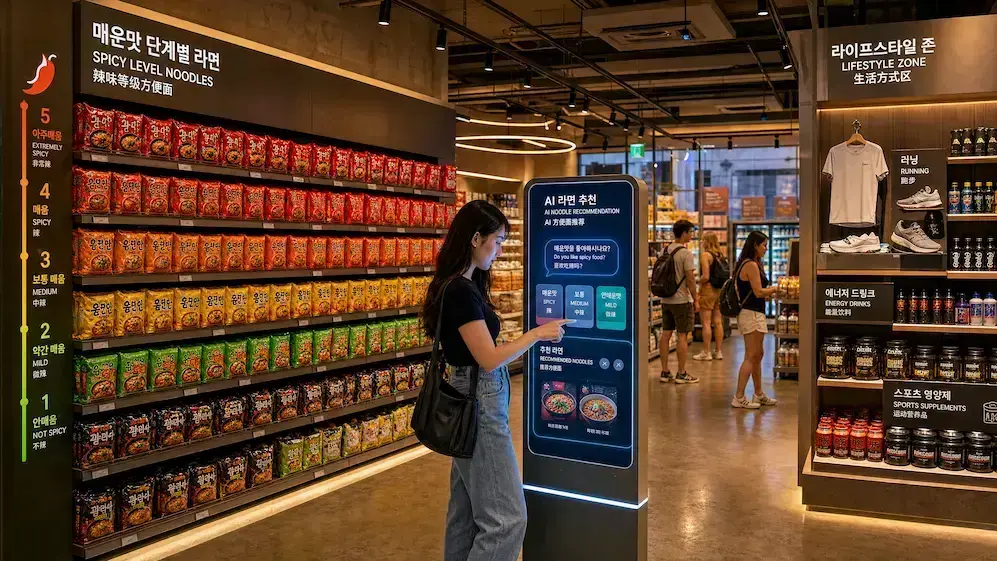
Occupying a two-storey building, this retail space functions as something between a museum, a marketplace, and an immersive cultural experience. The ground floor presents a curated selection of Korean cultural products—beauty items, entertainment merchandise, and artisanal food gifts. Yet the upper level reveals the establishment’s true ambition. A wall stretching 2.8 metres from floor to ceiling displays 170 varieties of instant noodles. Korean ramyeon sits alongside regional specialities, Japanese alternatives, and Indonesian variants. Each product is categorised by spice intensity across four colour-coded tiers, with accompanying signage rendered in Korean, English, Mandarin, and Japanese.
The company’s approach reflects a sophisticated understanding of its clientele, and represents a significant evolution in convenience store innovation Korea. As one Emart24 representative explained, “We sought to reflect how international visitors wish to prepare ramyeon—as they have observed Koreans doing in television dramas.” This is not mere merchandising; it is the curation of cultural authenticity through innovation in Korean retail.
The results have proven remarkable. Within the first months of operation, transactions conducted via foreign payment methods accounted for 32 per cent of total sales—a figure that dwarfs the national average of 2 per cent by a factor of sixteen.
Across the city, in the Seongsu district, a different species of convenience store innovation Korea flourishes. CU’s Seongsu Dessert Park represents a departure from conventional convenience store design. The establishment stocks approximately 30 per cent more confectionery than a standard outlet, yet its distinguishing feature lies in its interactive dimension. Customers may assemble their own dessert compositions, selecting from an array of components and flavours. It is, in essence, a laboratory for personal taste.
Again, the market response proved instructive. Foreign payment transactions accounted for 32 per cent of revenue within two months—a testament to the appeal of experiential retail for international consumers and the success of convenience store innovation Korea in capturing global interest.
Lifestyle as Retail Strategy: Korea’s Convenience Store Innovation
The ambitions of Korea’s convenience store operators have expanded beyond mere product curation. They now seek to embed themselves within the quotidian rhythms of specific consumer communities through Korea’s convenience store innovation that transcends traditional retail boundaries.
In February of this year, CU unveiled the Running Station, positioned along the Han River in Yeouido Park. This establishment transcends the conventional convenience store format and represents a bold expression of convenience store innovation Korea. It functions simultaneously as a retail outlet and as a dedicated hub for the running community that has flourished in recent years. Facilities include secure locker storage, changing rooms, and powder facilities for athletes in transit. Products are organised thematically—energy supplements, protective equipment, and recovery essentials occupy dedicated zones. A sports brand pop-up occupies premium shelf space, whilst a loyalty programme converts accumulated mileage into store credit.
The concept, which CU intends to replicate across eighteen locations along the Han River, represents a fundamental reconceptualisation of retail space and exemplifies how Korea’s convenience store innovation extends into lifestyle integration. The convenience store becomes not merely a place of transaction, but a social infrastructure for a specific lifestyle community.
GS25 has pursued a parallel strategy, though with a distinctly different cultural anchor, demonstrating the breadth of approaches within convenience store innovation Korea. The company operates team-themed convenience stores aligned with professional sports franchises. Two flagship outlets in Daejeon celebrate the Hanwha Eagles baseball club, whilst a location adjacent to Jamsil Baseball Stadium functions as an LG Twins outpost. The formula—team colours adorning the walls, memorabilia occupying shelves, match highlights displayed on screens—has proven sufficiently robust to warrant expansion into football. Stores themed around Ulsan HD FC and FC Seoul now operate under the same conceptual framework.
As a GS Retail representative noted, “GS25 has been at the forefront of sports-themed retail, becoming the first in the industry to establish team-branded convenience stores. We intend to build upon this momentum as interest in professional sports continues to intensify.” This commitment underscores GS25’s role in advancing convenience store innovation Korea through strategic brand partnerships.
The Invisible Architecture: AI Powering Convenience Store Innovation
Yet beneath these visible transformations lies a more profound transformation, one that operates largely beyond the perception of casual observers. The true competition, increasingly, unfolds not on shop floors but within data centres, where artificial intelligence systems process behavioural patterns and optimise operational efficiency. This technological dimension is central to understanding convenience store innovation Korea at its most sophisticated level.
Both BGF Retail, which operates the CU chain, and GS Retail have articulated explicit commitments to AI-driven transformation. At a shareholder meeting in March, BGF Retail’s Chief Executive Min Seung-bae declared, “We shall embed artificial intelligence capabilities across all operational domains, encompassing marketing and logistics. We shall undertake company-wide research and development initiatives to translate these capabilities into tangible, measurable outcomes.” This strategic vision positions AI as fundamental to the future of convenience store innovation Korea.
One manifestation of this commitment is an AI-powered in-store kiosk that analyses a customer’s personal colour profile to recommend cosmetic shades and facilitate the creation of customised beauty products. The convenience store thus becomes a venue for personalised beauty consultation, exemplifying how AI powering convenience store innovation transforms the customer experience.
GS Retail has pursued a complementary approach, centring its AI strategy upon behavioural data analytics. CEO Hur Suh-hong articulated the vision: “We aim to construct a virtuous cycle grounded in authentic customer behavioural data, whilst expanding investment in artificial intelligence and digital infrastructure to enhance our operational competitiveness.” This approach demonstrates how convenience store innovation Korea increasingly relies upon data-driven decision-making.
Practically, this manifests in AI-driven systems that manage inventory for food items, learning consumption patterns and automatically optimising stock levels. The convenience store clerk’s role evolves from reactive restocking to strategic curation, reflecting the broader transformation of convenience store innovation Korea into a technology-enabled ecosystem.
The Broader Significance of Korea’s Retail Transformation
The transformation of South Korea’s convenience store sector carries implications that extend far beyond the Korean peninsula. The global retail industry confronts identical pressures: the relentless expansion of e-commerce, demographic contraction in developed markets, and the fragmentation of consumer preferences. The Korean approach—specialisation, experiential design, AI-enabled personalisation—offers a potential template for retail reinvention.
Rather than competing on ubiquity, retailers might instead compete on purpose. Rather than treating stores as interchangeable units, they might be reconceived as community anchors, lifestyle facilitators, or cultural ambassadors. The convenience store innovation Korea model demonstrates that retail spaces can transcend their traditional function as mere points of sale.
When a foreign visitor stands before the wall of 170 noodle varieties at Emart24’s K-Food Lab, or assembles a bespoke dessert at Seongsu Dessert Park, or deposits their running shoes in a locker at the Han River Running Station, they are not merely shopping. They are participating in a retail ecosystem that has transcended the transactional and become genuinely experiential. This is the essence of convenience store innovation Korea—a transformation that speaks to Korea’s broader capacity for innovation and adaptation.
The convenience store, once dismissed as a mere convenience, has become something far more consequential: a laboratory for the future of retail itself. The convenience store innovation Korea phenomenon represents not merely a commercial success, but a fundamental reimagining of how retail spaces can serve their communities. This transformation will likely influence retail strategies globally for years to come.