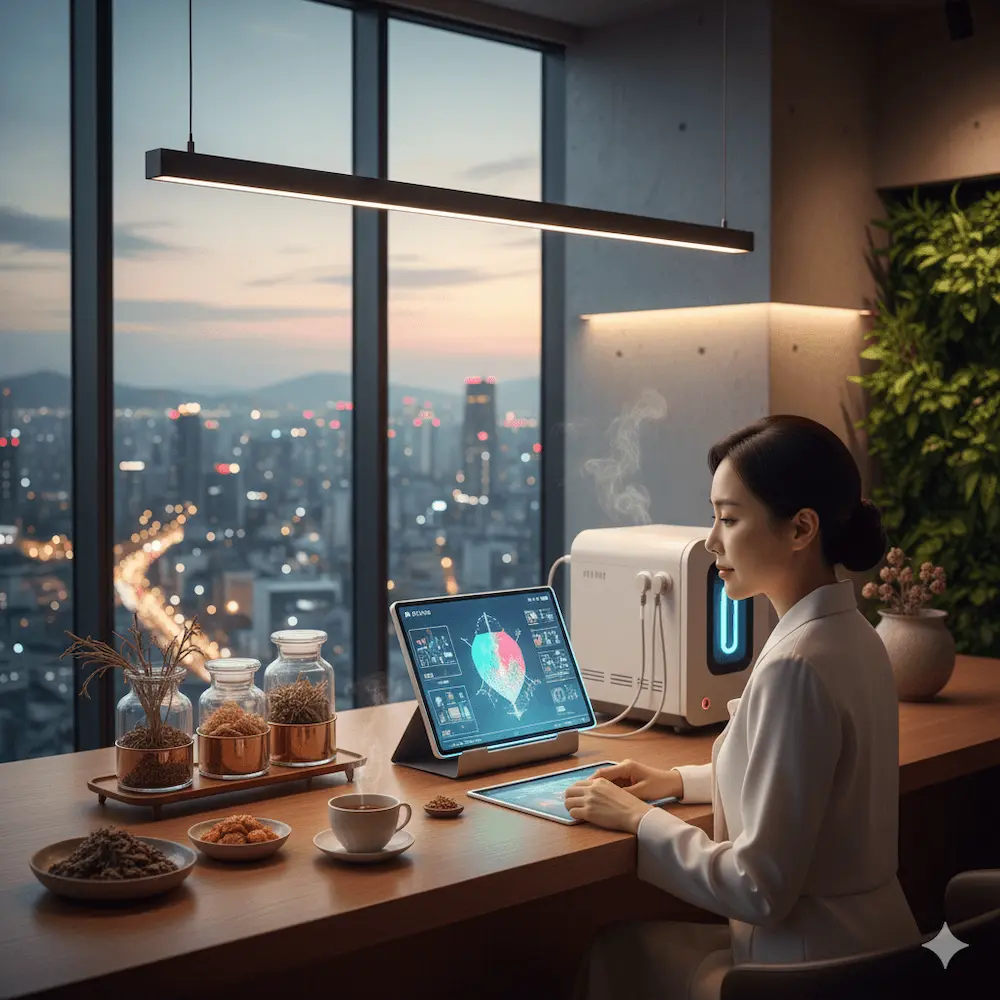
In the sophisticated digital heart of Seoul, a quiet paradox is unfolding. While the global tech industry races toward the next AI breakthrough, South Korea’s elite are looking backward to move forward. As we navigate through January 2026, the global beauty narrative has shifted from aggressive anti-ageing to the sophisticated art of “Slow-Aging.” This movement, deeply rooted in the Korean philosophy of Hanbang (traditional medicine), is not just about aesthetics—it is a strategic investment in long-term Healthspan.
1. The 2026 Pivot: From Anti-Ageing to Bio-Alignment
The era of “quick fixes” is officially over. Today’s wellness-conscious MZ generation and high-net-worth individuals are seeking “Bio-Alignment”—a state where skincare, diet, and internal health harmonise to delay the biological clock. In Korea, this is manifesting in the rise of Wellness Ateliers that combine AI-powered skin analysis with centuries-old herbal prescriptions.
Why the Global Market is Obsessed with K-Longevity
According to current 2026 projections, the South Korean skincare and wellness market has reached a valuation of approximately $13.24 Billion. This growth is primarily driven by the “Slow-Aging” segment, which has transitioned from a niche luxury to a mainstream lifestyle requirement.
2. The GABA Revolution: Why Sleep is the New Skincare
A standout feature of Korean Slow-Aging Wellness 2026 is the explosive growth of the GABA (Gamma-Aminobutyric Acid) market.
- The Data: Leading health and beauty retailer CJ Olive Young reported that in late 2025 and early 2026, sales of stress-relief and sleep-aid supplements containing GABA and Melatonin surged by over 300% year-on-year.
- The Science: GABA is a neurotransmitter that inhibits certain brain signals, reducing nervous system activity. In the 2026 Korean market, it is being branded as “Inner-Aging” care, essential for cortisol management and skin barrier recovery.
- Early Wellness: Purchasing data indicates that the 15-24 age group is now the fastest-growing segment for these functional supplements, a trend known as “Early Wellness.”
3. The F-1-D Visa Correlation: Wellness as a Professional Asset
A common question arises: What is the link between the Digital Nomad Visa (F-1-D) and Slow-Aging? The answer lies in the high-net-worth profile of the 2026 nomad.
- Income Threshold: To qualify for the F-1-D visa in 2026, applicants must prove an annual income exceeding ₩88,102,000 (approx. $66,000 USD). This is double Korea’s GNI per capita, ensuring that these residents possess significant disposable income.
- The “Glow-cation” Trend: These professionals are not just here to work; they are here to “optimise.” Over 40% of F-1-D visa holders integrate medical-grade wellness treatments—such as exosome therapy and personalised Hanbang nutrition—into their remote work schedule.
- Infrastructure Synergy: Seoul’s high-speed 6G pilot zones and 24/7 wellness concierges allow these nomads to maintain peak productivity while undergoing advanced longevity protocols.
4. The “F.U.L.L.M.O.N” Trend: 2026 Market Keywords
In its 2026 Trend Report, CJ Olive Young introduced the acronym “F.U.L.L.M.O.N” (Full Moon) to describe the overarching theme of “Wholeness.”
| Trend Segment | Meaning | 2026 Business Driver |
| Feel-Good Wellness | Daily Enjoyable Health | Expansion of functional gummies and RTD tea. |
| Unwind to Win | Recovery as Competitiveness | Surge in GABA, Melatonin, and Magnesium sales. |
| Layered K-Routine | Global Integration | Exporting Hanbang rituals to UK/US markets. |
| Medical-Home Loop | Professional to Home Care | Growth of home-use AI aesthetic devices. |
5. Strategic Insights for Global Business Partners
The Korean Slow-Aging Wellness 2026 ecosystem offers a unique “top-down” government-supported framework. The 2026 “Digital New Deal 2.0” has allocated over ₩9.9 Trillion for R&D in AI-driven healthcare, providing a robust foundation for cross-border tech partnerships.
Opportunity Corridors:
- SaaS Health Matching: Opportunities for Western developers to create interoperable apps for the 2,000+ Korean SaaS startups launching by 2027.
- Premium Ingredients: Demand for high-purity GABA and adaptogens (Mugwort, Fermented Ginseng) in the B2B supply chain.
- Wellness Real Estate: Development of “Longevity Hubs” in Seoul and Jeju Island catering to the international F-1-D nomad community.

Conclusion: Your Gateway to K-Wellness
The shift toward Korean Slow-Aging Wellness 2026 is more than a trend; it is a fundamental restructuring of the global health economy. By merging ancient Hanbang wisdom with 6G-era connectivity, South Korea has created a blueprint for the future of human longevity.
Are you a business owner looking to source premium Korean GABA supplements, or a professional seeking the F-1-D visa for a wellness retreat? Leave a comment below. Our team at CoreaDesk is ready to facilitate your entry into the world’s most sophisticated wellness market.
“Korean Slow-Aging Wellness 2026: The $13 Billion Longevity Economy”에 대한 1개의 생각