South Korea SMR export financing has emerged as the cornerstone of the global transition towards reliable, carbon-neutral energy. As the world moves beyond the initial hype of Small Modular Reactors (SMRs), the focus has shifted from mere technological feasibility to the sophistication of capital structures. In 2026, Seoul is no longer just manufacturing reactors; it is pioneering a de-risked financial ecosystem that global institutional investors find impossible to ignore.
The Shift from ‘Construction’ to ‘Strategic Asset Management’
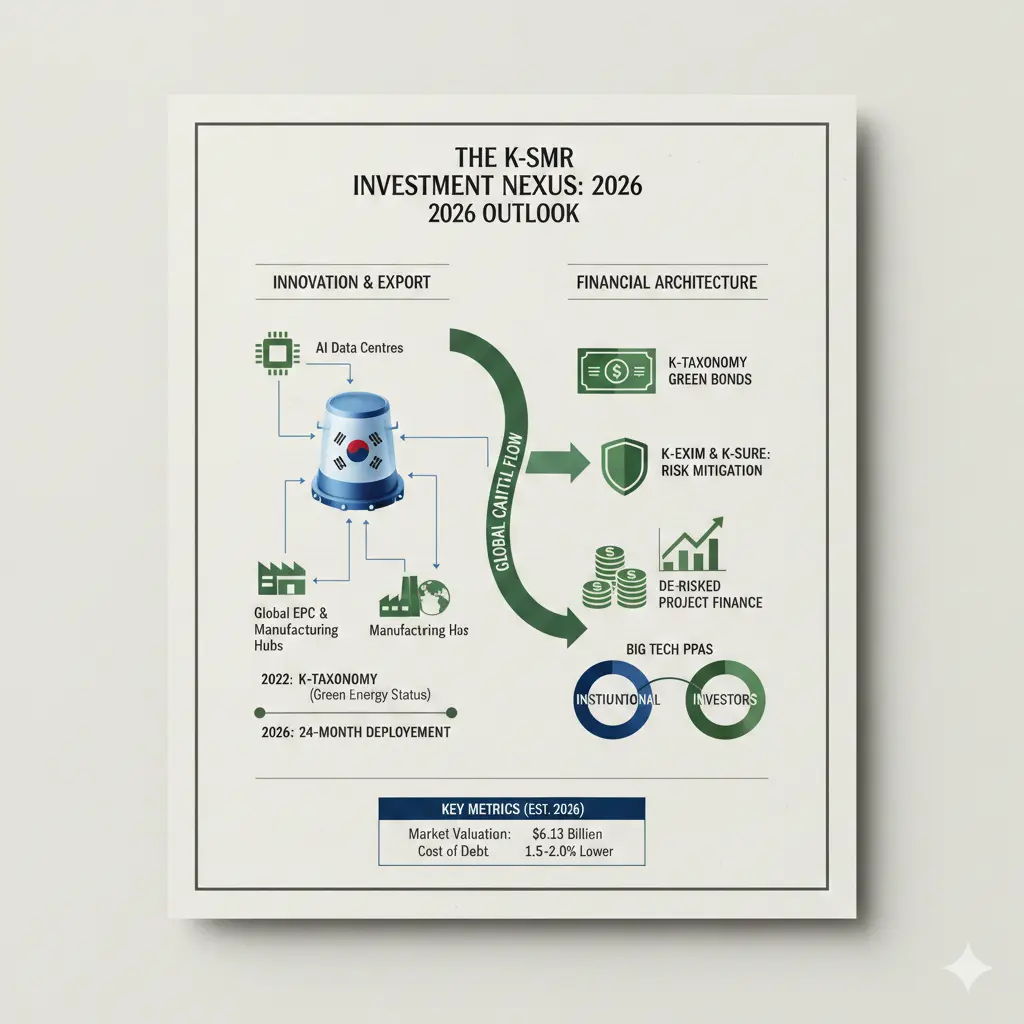
For decades, nuclear energy investment was plagued by prolonged construction timelines and the inherent volatility of interest rate exposure. However, the South Korean model has effectively decentralised these risks. By integrating SMRs into the K-Taxonomy Green Bond framework, the South Korean government has provided a sovereign-backed assurance that these projects are not merely industrial sites, but high-grade ESG assets.
“The inclusion of nuclear energy in the green taxonomy was the catalyst. It allowed pension funds and sovereign wealth funds to reclassify SMR projects from ‘high-risk infrastructure’ to ‘sustainable yield-generating assets’.” — Excerpt from 2026 Global Energy Finance Report.
This reclassification is critical. It enables SMR Project Financing (PF) to access lower-cost capital, significantly improving the Internal Rate of Return (IRR) for private equity participants. When the cost of capital decreases, the competitive edge of Korean EPC (Engineering, Procurement, and Construction) firms sharpens, creating a virtuous cycle of reinvestment.
The AI Synergy: SMRs as the Backbone of Global Tech Infrastructure
The surge in demand for AI Data Centre Power Solutions has fundamentally altered the buyer persona for nuclear energy. In 2026, the primary interlocutors for South Korean nuclear consortia are no longer just state utility companies, but the infrastructure arms of global tech giants.
The appeal of the Korean SMR model lies in its modularised deployment timeline. While traditional large-scale plants require a decade of patience, Korea’s standardised manufacturing allows for a 24-month deployment window. This agility aligns perfectly with the rapid scaling requirements of AI clusters. Through Direct Power Purchase Agreements (PPA), tech firms can lock in long-term energy security while meeting stringent Net Zero mandates.
The South Korean Competitive Edge (2026)
| Category | South Korea (SMR-Tech) | Global Avg. Competitors | Strategic Implications |
| Construction Lead Time | 24 – 36 Months | 60 – 80 Months | Minimises Interest Rate Exposure |
| Financing Mechanism | K-Taxonomy Green Bonds | Standard Industrial Loans | 1.5% – 2.0% Lower Cost of Debt |
| Risk Mitigation | State-backed Export Credit | Private Insurance Only | High-grade Sovereign Guarantee |
| Tech Scalability | Factory-built Modularisation | Site-specific Customisation | Rapid Replication & Cost Reduction |
Why Seoul Leads the Financing Race
The Export-Import Bank of Korea (KEXIM) and the Korea Trade Insurance Corporation (K-SURE) have introduced unprecedented credit enhancement tools. These tools are specifically designed to manage Nuclear Energy Investment Risk Management, covering everything from geopolitical shifts to regulatory changes in the host country.
For a British or American institutional investor, the Korean proposition is simple: world-class engineering backed by a sophisticated financial safety net. This “Turnkey Financing” approach—where the technology and the capital structure are exported as a single package—is precisely why global capital is gravitating towards Seoul.
Navigating the Next Super-cycle
As we navigate through 2026, the narrative surrounding SMRs has matured. We are entering a ‘Super-cycle’ where energy security is synonymous with national security and economic competitiveness. South Korea’s mastery over the SMR export financing landscape has positioned it as the indispensable partner for nations and corporations alike.
For the discerning investor, the message is clear: the most significant innovation coming out of Korea this year isn’t just the reactor itself—it is the financial architecture that makes it bankable.