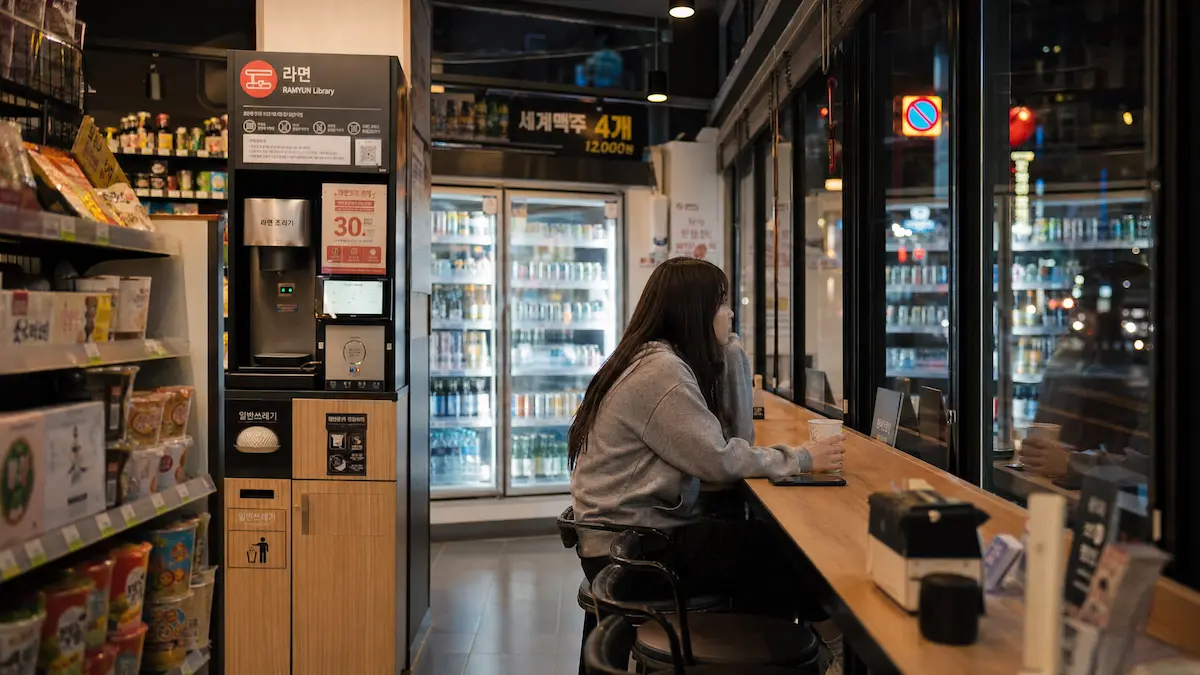
Walk into any Korean convenience store at 2 AM and you’ll find the place buzzing. Students hunched over laptops, night-shift workers grabbing a quick meal, friends meeting up for a chat, people just sitting quietly with a coffee. The fluorescent lights hum. The refrigerators buzz. It’s warm, it’s open, and it’s always there.
This isn’t just one store in one neighbourhood. It’s everywhere. South Korea has roughly 42,000 convenience stores—about 8 per 1,000 people. For context, the US has 2 per 1,000, Japan has 6. South Korea has created something genuinely different: a place that’s part shop, part second home, part social hub.
How It Started
In the 1980s and 90s, South Korea was changing fast. People poured into cities. Families scattered. Work hours got longer. The old ways of eating together at home, shopping at neighbourhood markets—that was disappearing.
The first Korean convenience store opened in 1989. By the 2000s, they were everywhere. They solved a real problem: you could grab food at midnight, pay your bills at 3 AM, pick up your online order whenever you wanted. For students in tiny dorms, young workers with crazy schedules, people living alone in the city—the convenience store wasn’t just helpful. It was essential.
More Than Just Shopping
Over time, the convenience store became something bigger. You could print documents, use an ATM, charge your phone. Prepared food appeared on the shelves—kimbap, gimbap, fried chicken, ramyeon. Delivery apps connected to the stores. They became distribution hubs for everything.
By 2024, the industry was worth about 20 trillion won annually. Around 3 million people worked in convenience stores, with roughly 2 million part-timers. The convenience store had become woven into Korean life.
Why People Love Them
There are real reasons why Koreans can’t imagine life without convenience stores.
Money matters. A bowl of kimbap costs 3,000-4,000 won. A full meal might be 5,000-6,000 won. For students, young workers, people on tight budgets—this is where they eat. Not because they love the food, but because they can actually afford it.
Time is everything. Korean work culture is intense. People work late. They eat late. They study late. The convenience store is open when they need it. It’s practical. It’s there.
Space is precious. A one-room apartment in Seoul might be 10 square metres. Tiny. The convenience store, with its lights and relative anonymity, becomes an escape. You can sit there for hours, buy one coffee, and nobody bothers you. It’s not home, but it’s better than home right now.
Community happens here. You meet friends at a specific store. You chat with the night-shift worker who knows your order. You see the same faces every night. It’s an odd kind of community, but it’s real.
The Harder Parts
Of course, there’s a flip side.
For workers, it’s tough. Most convenience store employees are young people working part-time for minimum wage—around 11,000 won per hour in 2024. The hours are irregular, often late at night. They deal with difficult customers. In 2024 and 2025, violent incidents against convenience store workers spiked. People assaulted staff over minor issues—a refund, a complaint. It sparked national outrage and calls for better protection.
Health-wise, it’s complicated. Convenience store food is cheap, but it’s often high in sodium and preservatives. People who eat there regularly face nutritional imbalances. Studies link frequent convenience store meals to higher rates of obesity and Type 2 diabetes, especially among young people.
Traditional shops struggle. Local restaurants and small markets can’t compete. Entire neighbourhoods have lost their traditional retail spaces. That’s a real loss.
Packaging waste is serious. The industry generates enormous amounts of plastic waste. Single-use bags, plastic containers, excessive wrapping. Environmental activists have rightfully criticised this.
Who Uses Them
The convenience store society isn’t the same for everyone.
MZ generation—millennials and Gen Z—grew up with convenience stores. For them, it’s completely normal. It’s where they eat, study, work, meet friends. K-dramas and K-pop feature convenience store scenes because they resonate with this generation.
Older Koreans use them, but less frequently. They’re more likely to shop at traditional markets or supermarkets. For them, it’s useful but not essential.
In rural areas, the situation’s different. Convenience stores exist but are less dense. Some villages have limited access to fresh, affordable food.
How It Compares
South Korea isn’t alone in having convenience stores, but the intensity is unique.
Japan has a strong convenience store culture, but it’s different. Japanese stores emphasise quality and variety. They’re popular, but not quite as central to daily life. In Korea, they’re essential.
The US has convenience stores, but they’re less ubiquitous and less culturally significant. Americans drive to supermarkets or use delivery services. The convenience store isn’t a refuge; it’s just a place to grab something quickly.
In developing countries, convenience stores are less common. Traditional markets and street vendors remain primary. The model requires infrastructure and purchasing power that not all countries have.
What It Reveals
The convenience store society tells you something about modern South Korea. It shows a society that values efficiency and accessibility. It shows a place where work dominates life, where people eat quickly and alone. It reveals economic inequality—the fact that so many rely on cheap convenience store food suggests many Koreans are struggling financially.
But it also shows resilience. Koreans took a simple retail concept and transformed it into something that serves multiple social functions. The convenience store isn’t just a business. It’s a social institution.
The Real Picture
Is the convenience store society good or bad? It’s both.
The stores provide affordable food, 24-hour access, and jobs for millions. For people working irregular hours or living in poverty, they’re genuinely helpful. They’ve become a cultural symbol where Korean identity is expressed.
But they also reflect unhealthy work culture, poor nutrition, environmental waste, and economic inequality. They’re a symptom of problems South Korea hasn’t fully solved—long work hours, low wages, housing costs, social isolation.
Most Koreans can’t imagine life without convenience stores. They’re too integrated. But the convenience store society also masks deeper issues that need addressing.
Looking Forward
The convenience store industry will keep growing. Automation might change things—self-checkout systems and robot staff are already being tested. Health concerns might push for more nutritious options. Environmental pressure might reduce packaging. But the fundamental model—24-hour, affordable, accessible retail—will likely stay.
What will probably change is the conversation around it. As awareness grows about health impacts, labour issues, and environmental costs, there may be more regulation, more demands for worker protection, and pressure for healthier food options.
The Bottom Line
If you’re visiting South Korea, the convenience store is unavoidable—and that’s part of understanding how modern Koreans actually live.
If you work in a convenience store, you deserve better conditions and better pay. The system needs to change.
If you’re a regular customer, it’s worth thinking about what that means for your health and your time. Convenience is useful, but it’s not everything.
The convenience store will remain central to Korean life. It’s efficient, it’s accessible, it’s always there. It’s also a window into modern Korea—a society that’s fast-paced, hardworking, and still figuring out how to balance work and life, tradition and modernity, individual needs and collective good.
References
[1] Statistics Korea (2024). “Retail Trade Survey: Convenience Store Sector.”
[2] Korean Convenience Store Industry Association (2025). “2025 Convenience Store Industry Report.”
[9] Yonhapnews (2024). “Convenience Store Worker Violence Incidents Surge in 2024.”