Artificial intelligence often appears on a screen as software.
A person types a question. A model produces an answer. A company adds an AI tool to a search engine, a phone, a document editor or a business platform. From the outside, the change can look almost weightless.
But AI is not weightless.
Behind every large model is a physical system: processors, memory chips, storage devices, networking equipment, cooling systems, electricity, water, factories, engineers and supply chains. If data cannot move quickly enough between processors and memory, even powerful computing systems lose efficiency.
This is why memory chips have become more important in the AI era than many people outside the semiconductor industry realise.
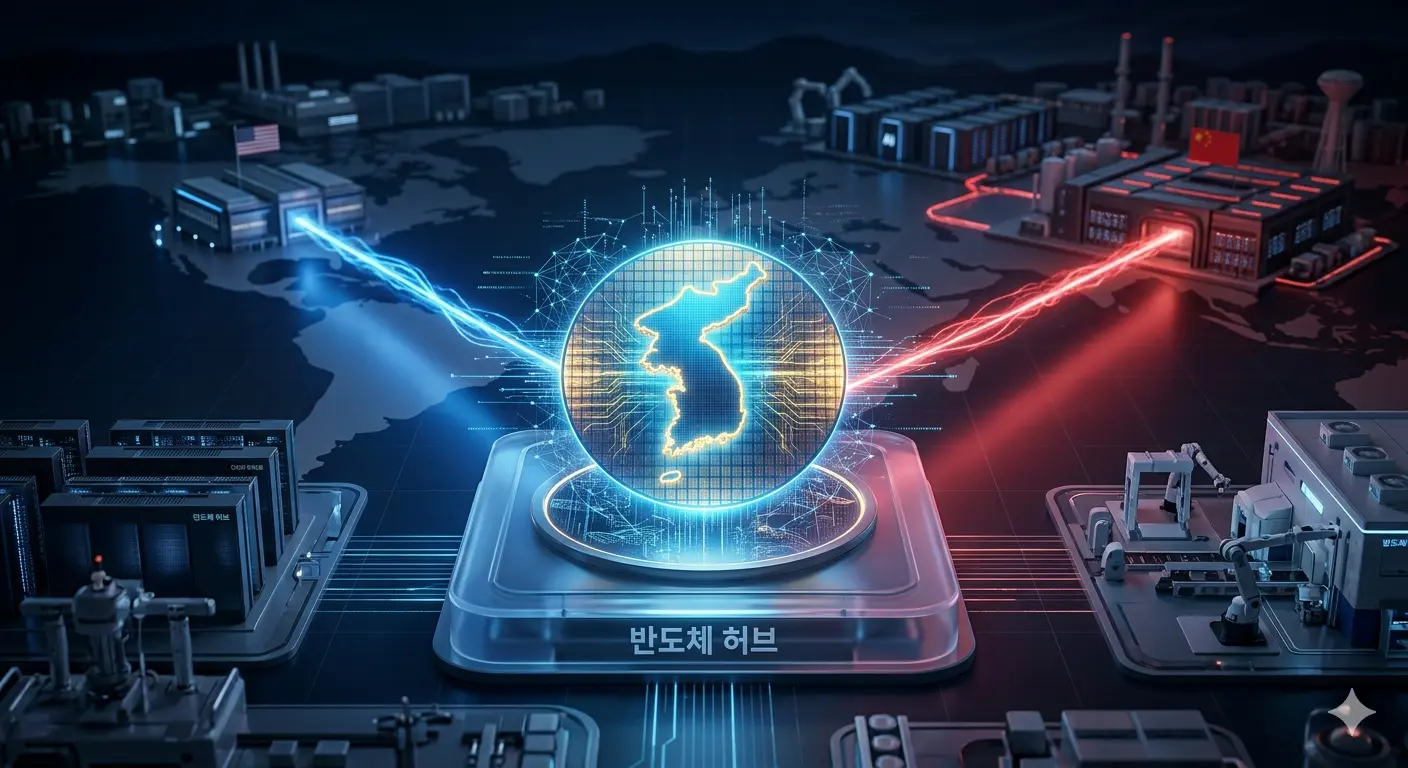
For South Korea, this shift matters deeply. Semiconductors are not just one export item among many. They are part of the country’s industrial base, trade balance, regional planning, university education and long-term economic strategy.
The Memory Bottleneck Behind AI
AI systems need enormous amounts of data to move at high speed.
A processor can perform calculations, but it cannot work efficiently if it spends too much time waiting for data. In advanced AI servers, memory bandwidth can become a serious constraint. This is one reason High Bandwidth Memory, commonly called HBM, has become so important.
HBM is a type of advanced DRAM designed to move more data at high speed within a compact space. It uses stacked memory dies and advanced packaging to provide far greater bandwidth than conventional memory structures used in ordinary computing systems.
In simple terms, HBM helps expensive AI processors work more efficiently.
That does not make HBM the only important technology in AI. The wider AI semiconductor supply chain includes logic chip design, foundry manufacturing, advanced packaging, equipment, materials, software, cloud services and power infrastructure. Taiwan, the United States, Japan, Europe and other regions all play important roles.
South Korea’s strongest position is memory.
Samsung Electronics and SK hynix are among the world’s major memory chipmakers. SK hynix has drawn strong attention for its position in HBM used in AI accelerators, while Samsung Electronics remains a major global memory producer and continues to invest in advanced memory generations.
A careful distinction is needed here.
South Korea does not control the whole AI chip supply chain. It does not replace Taiwan’s foundry strength or the United States’ role in chip design and cloud platforms. But in advanced memory, Korea remains one of the most important countries.
Semiconductors as an Economic Foundation
South Korea’s economy was built through manufacturing and exports.
Shipbuilding, automobiles, electronics, batteries and semiconductors all helped the country become one of Asia’s major industrial economies. Among these sectors, semiconductors now carry exceptional weight.
When chip exports are strong, Korea’s export data often looks healthier. When the memory cycle weakens, concerns quickly spread to growth, supplier companies, employment, investment and market sentiment.
This is why semiconductor news receives so much attention in Korea.
It is not only a technology story. It is also a national economic story.
In 2025, Korea’s ICT exports reached a record level. Semiconductor exports also reached a record high, supported by demand for AI-related memory products such as HBM and by stronger prices for general memory products.
For international readers, this may be easy to miss.
A café street, beauty store, food market or entertainment district is more visible to a visitor. But behind Korea’s modern economy, semiconductor production is one of the central engines.
The HBM Shift
The AI investment cycle has changed the memory market.
In older technology cycles, memory was often treated as a highly cyclical commodity business. Prices rose and fell with supply, inventory and demand from smartphones, personal computers and consumer electronics. That pattern has not disappeared.
But AI has added a new layer of demand for high-value memory products.
HBM is more difficult to produce than ordinary memory products. It requires advanced design, stacking, packaging, yield control and close qualification with major customers. This gives experienced memory manufacturers an advantage, but it also creates pressure.
Companies must invest before demand is fully certain. They must improve yields while moving to new product generations. They must coordinate with customers whose requirements can change quickly.
This is why HBM is not simply another memory product.
In AI servers, memory can help determine how efficiently expensive processors are used. That changes the economic value of memory technology.
For Korea, the opportunity is clear. The pressure is just as clear.
Industrial Clusters Are Built on Land, Water and Power
Semiconductors are not made in an abstract digital space.
They are produced in specific regions, inside fabrication plants that require land, power, water, roads, suppliers, logistics, safety systems and skilled workers.
In Korea, places such as Pyeongtaek, Hwaseong, Yongin and Icheon are closely tied to the semiconductor ecosystem. These areas are shaped by fabs, equipment suppliers, logistics networks, housing demand and local service industries.
The Korean government has promoted a large semiconductor mega-cluster in the southern part of the Seoul metropolitan area. The plan connects major chipmaking regions and companies with long-term investment, suppliers and research capacity.
This shows how semiconductor policy has moved beyond individual company strategy.
It is now treated as national industrial infrastructure.
The benefits can be significant. Large semiconductor investment can bring jobs, supplier growth, regional business activity and transport development.
But the pressure is also real.
Advanced fabs require stable electricity, large volumes of water, careful chemical management, roads, housing, emergency planning and environmental oversight. Construction delays, labour disputes or shortages of key materials can affect schedules. Local communities may benefit from investment, but they may also face congestion, land pressure and rising costs.
A serious semiconductor strategy therefore cannot focus only on export numbers.
It must also ask whether the places that host these factories can carry the weight of growth.
Talent Is Part of the Supply Chain
Semiconductor manufacturing depends on people as much as machines.
A modern fab needs process engineers, materials specialists, equipment technicians, software engineers, quality-control teams, safety managers, logistics planners and production workers. The machines are advanced, but they do not run themselves.
This is why semiconductor education has become important in Korea.
Universities, companies and government programmes have expanded attention to electrical engineering, materials science, computer engineering, semiconductor design, process technology and AI-related hardware research.
For young Koreans, the industry can look attractive because it offers technical careers at globally recognised companies. At the same time, it creates pressure. Competition for engineering programmes, internships and major company jobs can be intense.
From an industrial point of view, talent is not a separate social issue.
It is part of the production system.
Without enough skilled workers, investment in fabs and equipment cannot become long-term competitiveness.
Global Competition Has Become Political
The semiconductor industry has become geopolitical.
The pandemic exposed the fragility of global chip supply chains. Shortages affected automobiles, electronics and many other industries. Since then, governments have treated semiconductor capacity as a strategic concern.
The United States, Europe, Japan, Taiwan and South Korea are all investing in semiconductor production, research and supply-chain security.
This creates both opportunity and risk for Korea.
Korean companies have deep experience in memory manufacturing. But they now compete in a market shaped not only by customers and technology, but also by subsidies, export controls, technology restrictions, industrial policy and alliance politics.
Business competitiveness alone is no longer enough.
Companies must manage policy risk, customer concentration, equipment access, overseas investment decisions and geopolitical uncertainty.
The AI era has made advanced memory more valuable. It has also made the industry more exposed to political pressure.
Manufacturing Discipline Still Matters
Semiconductor production is one of the most demanding forms of manufacturing.
A fabrication plant must control dust, temperature, chemicals, timing, equipment performance and process variation with extreme precision. Small problems can affect yield, reliability and cost.
This is where Korea’s broader industrial history matters.
The country developed strong manufacturing capabilities through electronics, shipbuilding, automobiles, batteries and precision machinery. These industries required coordination among large firms, suppliers, engineers, logistics systems and export markets.
Semiconductors require an even higher level of discipline.
Korea’s advantage is not only that it has large companies. It is that those companies operate within a wider industrial ecosystem that understands high-volume manufacturing, supplier coordination and continuous process improvement.
That advantage is real.
It is not permanent.
Memory markets remain cyclical. Technology transitions are expensive. Competitors are investing aggressively. Demand forecasts can change. If AI investment slows, if supply expands too quickly, or if customer requirements shift, profitability can weaken.
A balanced view should recognise both Korea’s strength and the volatility of the industry.
What This Means for International Readers
Korea’s semiconductor industry affects more than Korea.
AI tools, cloud services, smartphones, servers, vehicles, gaming devices and data centres all depend on chips. Many of those systems need advanced memory, and Korean companies are major suppliers.
This helps explain why Korea’s economy is sensitive to global technology cycles. When AI infrastructure investment rises, Korean memory firms can benefit. When memory prices fall or demand weakens, the effects can move through exports, suppliers, regional investment and economic sentiment.
For visitors, this side of Korea is less visible than pop culture, food, cafés or shopping districts.
But it is one of the foundations behind the country’s modern economy.
In the AI era, semiconductors are not only a topic for engineers or investors. They are part of Korea’s industrial identity.
Korea’s position in advanced memory shows how manufacturing, talent, infrastructure and global technology demand are now tied together. It also shows why the country’s economic future depends not only on creating digital culture, but on producing the physical components that allow the digital world to function.
Technology and Industry Information Notice
This article is for general informational and industrial analysis purposes only. It does not provide investment, financial, legal or business advice. Semiconductor demand, export figures, company performance, market share, government policy and technology standards can change quickly. Readers should check official government data, company disclosures and independent industry research before making business, investment or policy decisions.
Sources and Further Reading
Ministry of Trade, Industry and Energy — Korea export and semiconductor trade data
Ministry of Science and ICT — ICT export and AI semiconductor policy updates
Korea.net — ICT export and semiconductor industry reports
JEDEC and technical resources on High Bandwidth Memory standards
Reuters reporting on HBM demand, SK hynix, Samsung Electronics and AI memory markets
Independent semiconductor research firms on memory cycles, HBM supply and market share
Google Search Central — Helpful, reliable, people-first content guidance